 Add to Chrome
 Add to Firefox
 Add to Edge
GeoBuildBench: A Benchmark for Interactive and Executable Geometry Construction from Natural Language
May 13, 2026
We introduce GeoBuildBench, a benchmark designed to evaluate whether large language models and multimodal agents can ground informal natural-language plane geometry problems into executable geometric constructions. Unlike existing geometry benchmarks that focus on answer correctness or static diagram interpretation, GeoBuildBench treats geometry diagram as an interactive construction task: given a textual problem, an agent must generate a domain-specific language (DSL) program to produce a diagram satisfying explicitly specified geometric objects and verifiable constraints. The benchmark features 489 Chinese textbook-style problems, curated through automated filtering and human validation to ensure text-complete, constructible problem specifications. We evaluate several state-of-the-art multimodal models in a bounded iterative setting and show that, despite reasonable success rates, models frequently exhibit structural hallucinations, missing objects, and failures to satisfy geometric constraints, with limited ability to exploit visual and constraint-based feedback for self-correction. These results highlight geometry construction as a rigorous testbed for grounded, executable reasoning beyond textual or visual plausibility. Our benchmark and code are publicly available.

Beyond Fixed Benchmarks and Worst-Case Attacks: Dynamic Boundary Evaluation for Language Models
May 07, 2026Evaluating large language models (LLMs) today rests on fixed benchmarks that apply the same set of items to any model, producing ceiling and floor effects that mask capability gaps. We argue that the most informative evaluation signal lies at the boundary, where the per-prompt pass probability is near $0.5$ under random-sampling decoding, and propose Dynamic Boundary Evaluation (DBE), which actively locates each model's boundary and places it on a globally comparable difficulty scale. DBE delivers three artifacts: (i) a calibrated item bank covering safety, capability, and truthfulness, with per-item difficulty labels validated across $9$ reference LLMs; (ii) Skill-Guided Boundary Search (SGBS), a search algorithm that finds boundary items for a given target LLM using only API-level query access; and (iii) an evaluation protocol that places a new LLM on a unified ability scale and grows the evaluation set adaptively when the target falls outside the bank's coverage. We instantiate DBE on four categories spanning safety (harmful request refusal and over-refusal), capability (constrained instruction following), and truthfulness (multi-turn sycophancy resistance). The resulting evaluation covers a broader model spectrum without saturation while remaining compatible with existing datasets.
Learning to Generate Formally Verifiable Step-by-Step Logic Reasoning via Structured Formal Intermediaries
Mar 31, 2026Large language models (LLMs) have recently demonstrated impressive performance on complex, multi-step reasoning tasks, especially when post-trained with outcome-rewarded reinforcement learning Guo et al. 2025. However, it has been observed that outcome rewards often overlook flawed intermediate steps, leading to unreliable reasoning steps even when final answers are correct. To address this unreliable reasoning, we propose PRoSFI (Process Reward over Structured Formal Intermediates), a novel reward method that enhances reasoning reliability without compromising accuracy. Instead of generating formal proofs directly, which is rarely accomplishable for a modest-sized (7B) model, the model outputs structured intermediate steps aligned with its natural language reasoning. Each step is then verified by a formal prover. Only fully validated reasoning chains receive high rewards. The integration of formal verification guides the model towards generating step-by-step machine-checkable proofs, thereby yielding more credible final answers. PRoSFI offers a simple and effective approach to training trustworthy reasoning models.
FREAK: A Fine-grained Hallucination Evaluation Benchmark for Advanced MLLMs
Mar 20, 2026Multimodal Large Language Models (MLLMs) suffer from hallucinations. Existing hallucination evaluation benchmarks are often limited by over-simplified tasks leading to saturated metrics, or insufficient diversity that fails to adequately assess the hallucination extent in state-of-the-art multimodal models. To address this gap, we propose FREAK, a comprehensive multimodal benchmark designed for fine-grained hallucination assessment in MLLMs. Through high-quality photorealistic images featuring fine-grained counter-commonsense edits, FREAK innovatively evaluates hallucination phenomena in detailed visual perception of MLLMs. Extensive experiments on FREAK show severe hallucination issues in SOTA models regarding detailed visual perception. To enable deeper investigation, we curate a controlled subset to indirectly evaluate the model's ability to perceive target detailed information. Through systematic evaluation of prevailing Chain-of-Thought (CoT) prompting techniques within this task, we reveal critical insights regarding hallucination patterns and model reasoning processes.
SWE-MiniSandbox: Container-Free Reinforcement Learning for Building Software Engineering Agents
Feb 11, 2026Reinforcement learning (RL) has become a key paradigm for training software engineering (SWE) agents, but existing pipelines typically rely on per-task containers for isolation. At scale, pre-built container images incur substantial storage overhead, slow environment setup, and require container-management privileges. We propose SWE-MiniSandbox, a lightweight, container-free method that enables scalable RL training of SWE agents without sacrificing isolation. Instead of relying on per-instance containers, SWE-MiniSandbox executes each task in an isolated workspace backed by kernel-level mechanisms, substantially reducing system overhead. It leverages lightweight environment pre-caching techniques to eliminate the need for bulky container images. As a result, our approach lowers disk usage to approximately 5\% of that required by container-based pipelines and reduces environment preparation time to about 25\% of the container baseline. Empirical results demonstrate that SWE-MiniSandbox achieves evaluation performance comparable to standard container-based pipelines. By removing the dependency on heavy container infrastructure, SWE-MiniSandbox offers a practical and accessible foundation for scaling RL-based SWE agents, particularly in resource-constrained research environments.
OLion: Approaching the Hadamard Ideal by Intersecting Spectral and $\ell_{\infty}$ Implicit Biases
Feb 01, 2026Many optimizers can be interpreted as steepest-descent methods under norm-induced geometries, and thus inherit corresponding implicit biases. We introduce \nameA{} (\fullname{}), which combines spectral control from orthogonalized update directions with $\ell_\infty$-style coordinate control from sign updates. \nameA{} forms a Lion-style momentum direction, approximately orthogonalizes it via a few Newton--Schulz iterations, and then applies an entrywise sign, providing an efficient approximation to taking a maximal step over the intersection of the spectral and $\ell_\infty$ constraint sets (a scaled Hadamard-like set for matrix parameters). Despite the strong nonlinearity of orthogonalization and sign, we prove convergence under a mild, empirically verified diagonal-isotropy assumption. Across large-scale language and vision training, including GPT-2 and Llama pretraining, SiT image pretraining, and supervised fine-tuning, \nameA{} matches or outperforms AdamW and Muon under comparable tuning while using only momentum-level optimizer state, and it mitigates optimizer mismatch when fine-tuning AdamW-pretrained checkpoints.
De-Anonymization at Scale via Tournament-Style Attribution
Jan 18, 2026As LLMs rapidly advance and enter real-world use, their privacy implications are increasingly important. We study an authorship de-anonymization threat: using LLMs to link anonymous documents to their authors, potentially compromising settings such as double-blind peer review. We propose De-Anonymization at Scale (DAS), a large language model-based method for attributing authorship among tens of thousands of candidate texts. DAS uses a sequential progression strategy: it randomly partitions the candidate corpus into fixed-size groups, prompts an LLM to select the text most likely written by the same author as a query text, and iteratively re-queries the surviving candidates to produce a ranked top-k list. To make this practical at scale, DAS adds a dense-retrieval prefilter to shrink the search space and a majority-voting style aggregation over multiple independent runs to improve robustness and ranking precision. Experiments on anonymized review data show DAS can recover same-author texts from pools of tens of thousands with accuracy well above chance, demonstrating a realistic privacy risk for anonymous platforms. On standard authorship benchmarks (Enron emails and blog posts), DAS also improves both accuracy and scalability over prior approaches, highlighting a new LLM-enabled de-anonymization vulnerability.
Conditional Memory via Scalable Lookup: A New Axis of Sparsity for Large Language Models
Jan 12, 2026While Mixture-of-Experts (MoE) scales capacity via conditional computation, Transformers lack a native primitive for knowledge lookup, forcing them to inefficiently simulate retrieval through computation. To address this, we introduce conditional memory as a complementary sparsity axis, instantiated via Engram, a module that modernizes classic $N$-gram embedding for O(1) lookup. By formulating the Sparsity Allocation problem, we uncover a U-shaped scaling law that optimizes the trade-off between neural computation (MoE) and static memory (Engram). Guided by this law, we scale Engram to 27B parameters, achieving superior performance over a strictly iso-parameter and iso-FLOPs MoE baseline. Most notably, while the memory module is expected to aid knowledge retrieval (e.g., MMLU +3.4; CMMLU +4.0), we observe even larger gains in general reasoning (e.g., BBH +5.0; ARC-Challenge +3.7) and code/math domains~(HumanEval +3.0; MATH +2.4). Mechanistic analyses reveal that Engram relieves the backbone's early layers from static reconstruction, effectively deepening the network for complex reasoning. Furthermore, by delegating local dependencies to lookups, it frees up attention capacity for global context, substantially boosting long-context retrieval (e.g., Multi-Query NIAH: 84.2 to 97.0). Finally, Engram establishes infrastructure-aware efficiency: its deterministic addressing enables runtime prefetching from host memory, incurring negligible overhead. We envision conditional memory as an indispensable modeling primitive for next-generation sparse models.
Synthesize Privacy-Preserving High-Resolution Images via Private Textual Intermediaries
Jun 09, 2025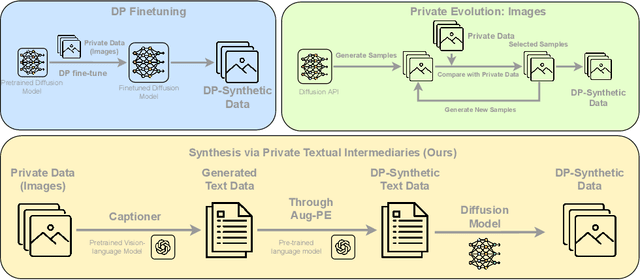
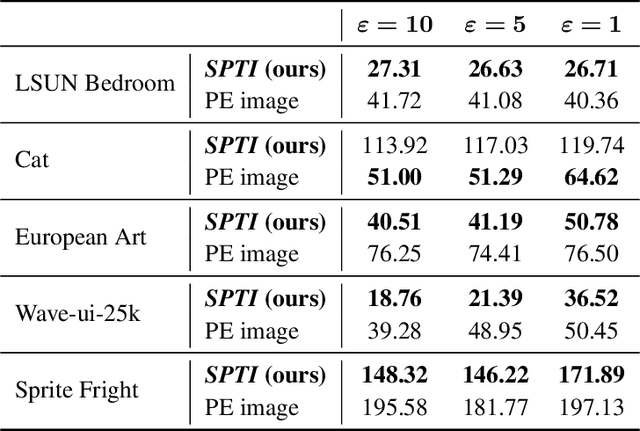
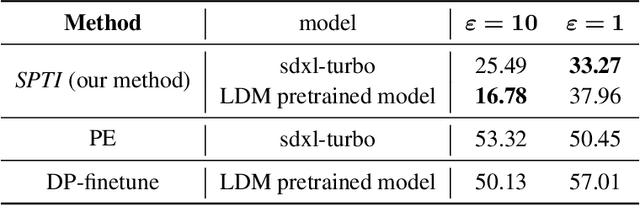
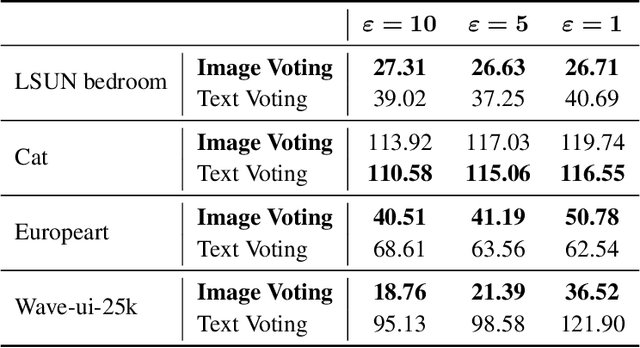
Generating high fidelity, differentially private (DP) synthetic images offers a promising route to share and analyze sensitive visual data without compromising individual privacy. However, existing DP image synthesis methods struggle to produce high resolution outputs that faithfully capture the structure of the original data. In this paper, we introduce a novel method, referred to as Synthesis via Private Textual Intermediaries (SPTI), that can generate high resolution DP images with easy adoption. The key idea is to shift the challenge of DP image synthesis from the image domain to the text domain by leveraging state of the art DP text generation methods. SPTI first summarizes each private image into a concise textual description using image to text models, then applies a modified Private Evolution algorithm to generate DP text, and finally reconstructs images using text to image models. Notably, SPTI requires no model training, only inference with off the shelf models. Given a private dataset, SPTI produces synthetic images of substantially higher quality than prior DP approaches. On the LSUN Bedroom dataset, SPTI attains an FID less than or equal to 26.71 under epsilon equal to 1.0, improving over Private Evolution FID of 40.36. Similarly, on MM CelebA HQ, SPTI achieves an FID less than or equal to 33.27 at epsilon equal to 1.0, compared to 57.01 from DP fine tuning baselines. Overall, our results demonstrate that Synthesis via Private Textual Intermediaries provides a resource efficient and proprietary model compatible framework for generating high resolution DP synthetic images, greatly expanding access to private visual datasets.
AdamS: Momentum Itself Can Be A Normalizer for LLM Pretraining and Post-training
May 22, 2025We introduce AdamS, a simple yet effective alternative to Adam for large language model (LLM) pretraining and post-training. By leveraging a novel denominator, i.e., the root of weighted sum of squares of the momentum and the current gradient, AdamS eliminates the need for second-moment estimates. Hence, AdamS is efficient, matching the memory and compute footprint of SGD with momentum while delivering superior optimization performance. Moreover, AdamS is easy to adopt: it can directly inherit hyperparameters of AdamW, and is entirely model-agnostic, integrating seamlessly into existing pipelines without modifications to optimizer APIs or architectures. The motivation behind AdamS stems from the observed $(L_0, L_1)$ smoothness properties in transformer objectives, where local smoothness is governed by gradient magnitudes that can be further approximated by momentum magnitudes. We establish rigorous theoretical convergence guarantees and provide practical guidelines for hyperparameter selection. Empirically, AdamS demonstrates strong performance in various tasks, including pre-training runs on GPT-2 and Llama2 (up to 13B parameters) and reinforcement learning in post-training regimes. With its efficiency, simplicity, and theoretical grounding, AdamS stands as a compelling alternative to existing optimizers.